Sunday, May 12, 2013

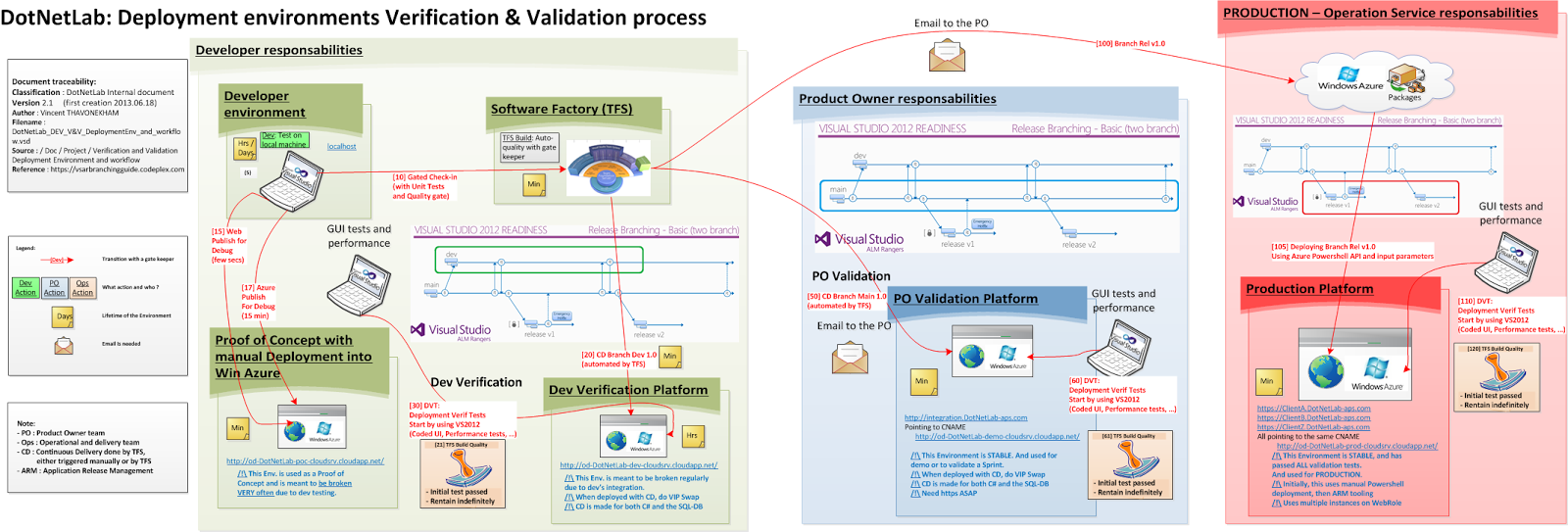
[DevOps / DevCloud] Wanna go beyond 'demo effect' and push your app into REAL production ?


OBSERVATION
Over the past few years, I am facing the following facts :
  • We want to produce to best of the best application according to all possible "best practices" and recommendations (Code quality, tools, methods, Agility vs. micro-management, waterfall, real world constraints, ...),
  • Things seem to be so easy, because we got presented trivial demos or we only considered "Proof Of Concepts". 
As it seems to be so easy to develop and market our application!
Watch out!! Have you thought about the following?
  • Taken into account real delivery and operation constraints :
    •  ITIL v3 (support, billing, delivery, licensing, ...), DevOps or DevCloud, legal aspects, IT security people, ...
  • The IT industry is moving so fast that to beat competitors, many software companies are claiming they can address your problem and is only presenting you trivial cases and we tend to focus only on development aspects. .
However, once the developments are completed, you are left with:
  • No budget beyond development, to address many operational topics!!
  • No time left because delivery and operational aspects are more difficult than expected
  • You don't know how to deliver on time because of unexpected purchases you have to do (production licensing, buy an alternative deployment tool, because the one considered only managed to deploy your easy trivial demo...),
  • You forgot to consider backups, disaster recovery, SLA, maintenance, and retirement of the application (with the associated cost of the cleaning up all backups).
The solution is obvious! 
Think up front, and start small BUT up until the end of the chain, with real-world constraints
  • Development, "true" test, deployment with real-world constraints (true DNS, true SLL certification ...), monitoring of the production instance ...

    This is to force you address topics that could be uncovered... and fail fast if you are stuck in front of a wall!
  • Use Agility and DevOps / DevCloud to face real problems:
    "Think big, act small, fail fast; learn rapidly" (cf. 
    Lean software development)

Easy to say, what can I do about it?
Based on my numerous ALM experiences and on experts around me, I have created a Microsoft .Net Lab
It is a gathering of experts, sponsored by ObjetDirect, where various people from the fields are sharing their experience and real-life problems. Then, this experience is "instantiate" (=“coded” and documented) as a large project to:
  • highlights real-life issues
  • show how to address them (if possible)
  • or find a hack around.

Zoom on the 'Dev' part: The TFS+VS 2013 Software Factory


Wednesday, April 24, 2013

At Seattle / Redmond working with Microsoft for ObjetDirect


I moved to another position, now working with ObjetDirect - France - as a Manager.

I'm in charge nationwide of the Microsoft Practice by developing our businesses and activities on at least the following topics:
  • ALM Software factory, 
  • Windows Azure, 
  • Microsoft consulting and development,
  • any other Microsoft technologies.
ObjetDirect, founded 15 years ago, addresses any domains that relates to software development and has developed agile methodologies and extended expertise on HTML5, Java, C/C++, PHP, Android, iOS, Enterprise Architect (by SPARXsystems). We are part of a larger company VISEO that takes care of complementary aspects (eg. SAP, BI, ...).

Obviously everything we're doing here is fully Agile ; why would I join ObjetDirect otherwise ?!?!
In addition, we are the sole company in France entitled to deliver Innovation Games® certified training, and we are very active as a community.

I got the opportunity to be invited by Microsoft on a worldwide NDA partnership in Redmond, to get trained and provide inputs on upcoming technologies (more info here).


Evening time: Seattle - Space Needle 


I would like to thank ObjetDirect and Edouard Danel, our CEO, whom I had the chance to meet though my numerous network in Paris (ranging from Agile, .Net, to PNL and "Transactional analysis"...).


The massive campus (like a town, and takes me about 30 min running from 1 building to another !!), all green grass and trees, and where we eat evening time:


Monday, February 18, 2013

NDepends... or How to pass your code quality audit ?

If you belong to a large organization, when developing an application, you might have to go through a code quality audit, done by a third party company that has the power to say 'Go' or 'No go', and provide advices if not good.

As far as I am concerned, I appreciate it because it forces us to care even more about code Quality and maintainability (which includes security, performance, Design...). Maintainability is particularly important because once in production, the Dev team will hand-over their code to the Maintenance Team.

Because such audit consists in watching numerous aspects, it all brings me back to an old post of mine listing the number of rules that FxCop and StyleCop monitors. Where the various rules are grouped into  the following categories :

FxCop (or its variation integrated within Visual Studio called Code Analysis, or CA, that compiles your code then analyse it):
  • Design
  • Globalization
  • Interoperability
  • Maintainability
  • Mobility
  • Naming
  • Performance
  • Portability
  • Reliability
  • Security
  • Usage
StyleCop (or Source Analysis)
  • Documentation
  • Layout
  • Maintenability
  • Naming
  • Ordering
  • Readability
  • Spacing
It totals about 400 rules. After having enforced most of them on various projects, it can be noticed the following pattern:
  1. Developers find it painful to comply to containing rules, as opposed to "no rules" at all of "his own home-made rule",
  2. Since the developers DONT have to learn all 400 rules at before hand, but ONYL progressively, it is not too bad. Moreover, with the help of Resharper, this tool reformats tedious painful and repetitive work automatically (Resharper can connect to FxCop and StyleCop so that it changes your code accordingly)
  3. Because of the Software Factory preventing check-in in any code that is NOT compliant to the given rules (NOTE: You have to determine with your team, which rule are compulsory, and which ones are not), the developers HAVE to follow the rules,
  4. Finally, within few months of coding, a survey done in the teams I have been working with shows that developers got used to it,
  5. And last, it becomes irritating for them to read code that IS NOT compliant (just like reading a book with plenty of grammar and spelling mistakes).
 Now that you've reached step 5, what should you do about the external audit that has been enforced by your sponsors or the Quality Management team ?


It's where NDepends enters into play ! It's a software that I have been using for nearly 10 years, written by Patrick Smacchia (author of books and blog dedicated to .Net, C# and Code Quality).

As far as we are concerned, the auditor came in and has inspected meticulously all aspects of our projects technically (the audit consisting in evaluating our Agility/Scrum process was done by another company) :
  • all our source code,
  • our DLLs and PDBs
  • our web services
  • and architectural diagrams

One snapshot will not be sufficient, because it's only when you can play visually with your code through Drill-Down (up until the exact line of code) that you could understand its power.

Where to start ?

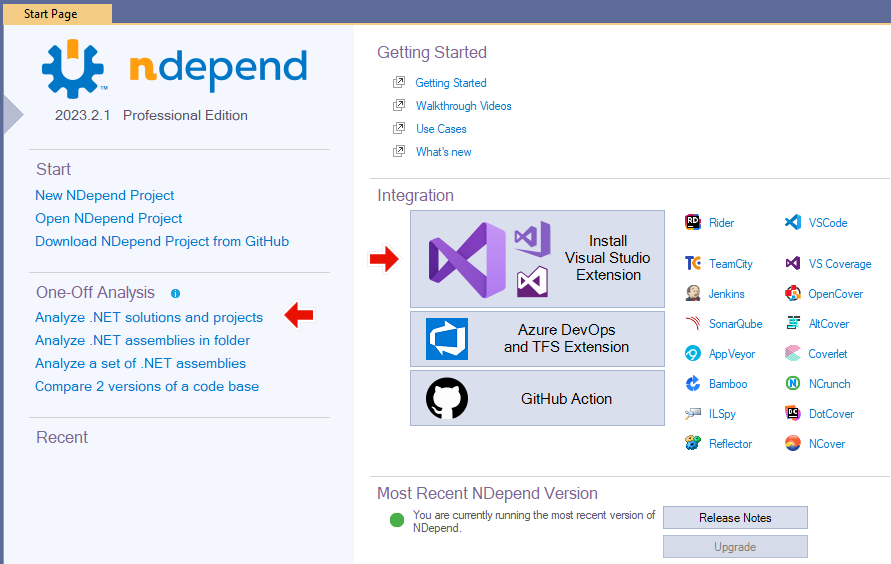
You have to "feed" NDepend with as much info as you can (*.Sln, *.csproj, DLLs, PDB, ...) in a Drag & Drop manner, then it could "answer" many of your technical questions concerning your projects.

Indeed, for me it considers your "project" (Source Code, PDB, DLLs, previous version of your source code, new code, ...) as a LARGE database, wich MANY different views (too much to fit in a single Snap shoot):


 where you could :
           Simple example:

from m in Application.Methods  
where m.NbLinesOfCode >  30  && m.IsPublic
select m


           More sophisticated sample:
// UI layer shouldn't use directly DB types
warnif count > 0


// UI layer is made of types in namespaces using a UI framework
        let
 uiTypes = Application.Namespaces.UsingAny(
                 
Assemblies.WithNameIn("PresentationFramework", "System.Windows",
                                       
"System.Windows.Forms", "System.Web")
              
).ChildTypes()

// You can easily customize this line to define what are DB types.
let dbTypes = ThirdParty.Assemblies.WithNameIn("System.Data",

"EntityFramework", "NHibernate").ChildTypes()
              
.Except(ThirdParty.Types.WithNameIn(
"DataSet"
, "DataTable", "DataRow"))

from
 uiType in uiTypes.UsingAny(dbTypes)
let dbTypesUsed = dbTypes.Intersect(uiType.TypesUsed)
select new { uiType, dbTypesUsed }


  • Identify through its build-in Quality rules (that extend considerably FxCop and StyleCop quality rules, or you could create your own ones)
        The list of the thousands of build-in rules is listed here.


  • Share a large amount of static results as a website, such as the one below that helps you find within seconds whether you have poorly designed components or not, and follow its evolution


  • Having a professional auditor in front of us, it took him only 1 day to decompose our work and start providing us feedback. Within this very same time, he managed to better understand part of our code than our developers ! To do so, he used many tools ... including one called ... NDepend !

    After having eliminated many "false positive" (since he does not know the context of our project), we managed to pass our audit with success and excellent grades !

    As per today, I am using the version 4.1.0.6871 (which incorporates a stand alone version as well as a VS 2010 and VS 2012 add on to play directly with your source code).
    Have a great audit !

    Monday, November 12, 2012

    Now you are Agile, what next ? Lets consider Transactional Analysis (French: Analyse Transactionnelle)


    I wanted to have a quick post on Transactional Analysis, which is a  psychology/psychotherapy discipline I heard about for years, 
    mainly influenced by Freud, but I never had the chance to investigate into. Well not until tonight.

    Scrum / Agile / XP ... has got some set of tools defined (daily stand up, iterations, scrum cards, ...). But those are only recipe. However, as opposed to traditional V-Cycle / Waterfall / PRINCE2, those basic tools are not enough to succeed in a project. What is required then is the soul and the conviction to improve yourself and the team ?

    Once you've also got the soul in place, to best achieve some improvements, you now have to 
    - analyse patterns of success using Scrum Patterns, or in fact more precisely patterns of failure so that you don't do them, or so that you identify them and get rid of them:  http://en.wikipedia.org/wiki/Scrum_pattern (definition that I have initiated by the way)
    - consider Dev’s team communication, but also the entire human interaction within the company.

    That’s where soft skills tools comes into play, where 2+2 is not necessarily 4, as opposed to computing (except in some cases geeks would say), but it only depends on many external parameters that we have to understand.

    Transactional Analysis as one of them, but let also mention Neuro linguistic programming (aka NLP, PNL in French), and a more “simplistic one” is the PCM©, Process Communication Management©)

    A French book that I would recommend, is “L’analyse Transactionnelle” René de Lassus © MARABOUT 1991, that I wish to quote 1 page (at the end), that is not meant to summarize the technique, but rather it means to me SOOOOO much in understanding my environment.

    It’s worth only 2,75€, so please get it from http://www.amazon.fr/Lanalyse-transactionnelle-Rene-De-Lassus/dp/2501027647 as I did, or anywhere else.

    Also consider having a look at PCM© as it is an even easier principle to understand, but as any soft skills, requires lots of practices and training.

    Obviously, even if you are not Agile, those techniques are also useful to understand hunain's interactions !!

    References:


    Thursday, August 2, 2012

    8Years-Study_Waterfall_vs_Agile

    I wanted to share you 1 slide: 
    Waterfall vs Agile project's success rate from 2002 to 2010

    No comments!

    Thursday, July 12, 2012

    Send email for free with Windows Azure


    From this documentation https://www.windowsazure.com/en-us/develop/net/how-to-guides/sendgrid-email-service/, here is a way to send emails for free provided it is less than 25,000 emails.
    image
    After some verifications from SendGrid that you are not a spammer, you will have access to the SaaS portal:
    image
    Configure your account in few steps, then everything is OK to send emails.
    image

    From your portal, you have access to the statistics
    image

    Emails that are Bounced, Blocked, Invalid, … are presented here:
    image
    As a .Net developer, simply add a Nuget into Visual Studio:
    SendGrid NuGet package
    Within your .Net code, simply use the information you filled in:
    image
    And here you go:
    // Create network credentials to access your SendGrid account.
    var username = "your_sendgrid_username";
    var pswd = "your_sendgrid_password";

    var credentials = new NetworkCredential(username, pswd);
    For more info: https://www.windowsazure.com/en-us/develop/net/how-to-guides/sendgrid-email-service/
    and http://sendgrid.com
    By the way, their Technical support is really quick to reply (less than an hour), based on the SaaS CRM: www.zendesk.com