Traps to consider when implementing "Software Factory" and DevOps.
It's in French, and I can create an English version on demand.
Showing posts with label Visual Studio 11. Show all posts
Showing posts with label Visual Studio 11. Show all posts
Wednesday, June 12, 2013


Tuesday, April 3, 2012
Lesson learned: ALM with SQL Azure and new tools (SQL Server Data Tools and latest DACPAC Data-Tier Application project)
The number of tools, either in CodePlex, in CTP, or MS released, or Third-party to manage the Windows Azure are numerous. To add some more complexity, the very same tool (e.g. SQL Management Studio), allows you to perform the same action but using many possible ways. Thus the degree of freedom is huge. However, not ALL combination works or sometimes not documented at the moment, or you have to find a KB to understand why it does not work the way it should.
This post provides an easy way of migrating your on-premise database into SQL Azure, and use the latest Microsoft tools to have a better SQL ALM than ever before.
After having migrated your on-premise database, by completing the first 4 steps from my previous post (the other steps just provide a ways to check the integrity of your migration), you’ll need to create a DACPAC project. However, this time you’ll be using the following latest Microsoft tools:
* SQL Server Data Tools [free], that extend your Visual Studio 2010 capabilities http://msdn.microsoft.com/en-us/data/gg427686 (check all pre-requisites, which could take up to 1 hour of install). You could consider using Visual Studio 11 Beta… but only for SQL Azure / DACPAC projects (Indeed, Windows Azure bit is another story with VS11 Beta).
This extension allows to work with *.sql file in a better way, as we will see later.
.png)
* SQL Server 2012 Management Studio [currently, get it SQL Server 2012 and uncheck everything, except Management Studio].
I would recommend not using SQL Management 2008 (unless you want to have some frustrations). indeed, with the latest version of Data-Tier Application projects it presents some minor limitations/ (bugs ? It’s a feature ? ) and its working principles has been ‘improved’ in “SQL Server 2012 Management Studio”.
To create a new type of Data-tier Application project, called “SQL Server Database project” within Visual Studio 2010, follow step 5 to 7 of my previous post mentioned above (as a reminder, you need to install SQL Server Data Tools).
You could also let “VS2010 with SQL Server Data Tools” migrate an existing VS2008 DB project:

In the new type of DB project’s property, you should target the “SQL Azure” platform, and set the Data-tier Application properties to a suitable version number (this number is used by the “intelligence” of DACPAC that is now handed by SQL Server 2008 R2 or 2012. We don’t deploy any longer “stupid” *.sql files).

It could be noted that by using this new type of DB project, you could decrease your amount of *.sql files considerably. For instance, going from 800 files to 100 files, depending on the complexity of your database. This is due to the fact that the new one is organized differently:
* No more huge amount of crazy sub-sub-sub-sub-folder and numerous files for every single index, constraints, etc… . Here is an example of a old VS2008 DB project applied to a very basic and small project (ASP.Net membership provider):
The gain in the number of files also means less files to get/check-in and track in terms of source control.

You could notice also few variations in the “Build” options on the *.sql file’s properties (3). However, unless setting additional deployment files to Build=”None” or “Build Extension Configuration” I did not manage to make it work properly (as in VS2008) when using related *.sql files called from a master *.sql file using the “:r” option.
With this type of project, by targeting “SQL Azure”, which represents the most constraining scenario (because your T-SQL has to be cleaned-up), you can publish either On-Premise or on SQL Azure using the very same T-SQL (you might add some IFs if you really need specific SQL instructions on SQL Azure).
As far as Publishing is concerned, you could define a configuration file per environment (e.g. click (1) to load various profiles, such as on-premise staging,on-premise validation, localhost, SQL Azure staging, SQL Azure PROD, …). To get the new publish window (notice it is not called “deploy” anymore), right click on your VS DB project > “Publish…”, somehow wait for 2 to 10 seconds before the modal pop-up appears:
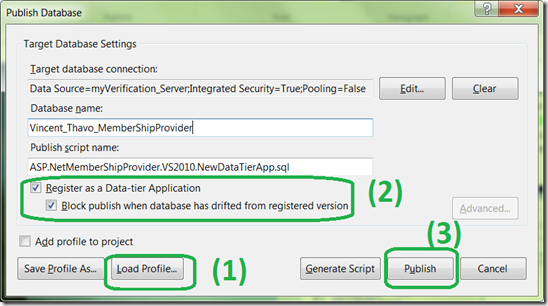
Ensure you have checked the 2 options (2) to benefits from the latest DACPAC type of deployment, and simply click (3) [which also means you could deploy the old fashion way by configuring the numerous options on Advanced…].
During the publishing, you’ll see a new output window that keeps it nice and tidy as opposed to the previous plain text version. It reminds me the Publish for Windows Azure, … but in a more usable way ! (i.e. no tiny reports with a tiny scrollbar and when a bugs occur, you don’t know what happens). I like this new “Data Tools Operations” output window :
- it has many “view details” links to open a full-size window when needed
- it could be collapsed (such as Win Azure deployment)
-…
. It also seams to deploy/publish and generate data a lot faster that its previous version (may be due to better caching).

Now if you want to deploys into SQL Azure, simply load the corresponding config file, then here you go, it’s on SQL Azure in 1 click ! Now you could use a command line to perform that so that a TFS-Build could automatically publish that for you (I would not recommend, since it will start to impact considerably you Windows Azure bill if you publish continuously 10 or 20 times a day for instance).
Example of deployment time a database with less that 100 MB data to be populated
- on local DB : 5 sec
- on SQL Azure (broadband): 4 min
- on SQL Azure (USB Dungle Internet, and no broadband): 15 min
The last new feature that I am going to present to really ease your ALM is the “Snapshots” possibilities. Before any Staging or Prod deployment, keep track of the exact deployment package that you delivered and stores it as a Snapshot. It will store you project as a DACPAC file within seconds (recall: a DACPAC file is a Zip file of you DB schema stored as XML files), which should then be stored into you favorite code repository. In TFS, for example, it could be a TFS-Release-Branch.

The new possibilities allows a huge gain in productivity !!!
Although I have been using those tools on large projects, I would be really interested in anyone having further practical feedbacks, or may be different usage.
This post provides an easy way of migrating your on-premise database into SQL Azure, and use the latest Microsoft tools to have a better SQL ALM than ever before.
After having migrated your on-premise database, by completing the first 4 steps from my previous post (the other steps just provide a ways to check the integrity of your migration), you’ll need to create a DACPAC project. However, this time you’ll be using the following latest Microsoft tools:
* SQL Server Data Tools [free], that extend your Visual Studio 2010 capabilities http://msdn.microsoft.com/en-us/data/gg427686 (check all pre-requisites, which could take up to 1 hour of install). You could consider using Visual Studio 11 Beta… but only for SQL Azure / DACPAC projects (Indeed, Windows Azure bit is another story with VS11 Beta).
This extension allows to work with *.sql file in a better way, as we will see later.
* SQL Server 2012 Management Studio [currently, get it SQL Server 2012 and uncheck everything, except Management Studio].
I would recommend not using SQL Management 2008 (unless you want to have some frustrations). indeed, with the latest version of Data-Tier Application projects it presents some minor limitations/ (bugs ? It’s a feature ?
) and its working principles has been ‘improved’ in “SQL Server 2012 Management Studio”.To create a new type of Data-tier Application project, called “SQL Server Database project” within Visual Studio 2010, follow step 5 to 7 of my previous post mentioned above (as a reminder, you need to install SQL Server Data Tools).
You could also let “VS2010 with SQL Server Data Tools” migrate an existing VS2008 DB project:

In the new type of DB project’s property, you should target the “SQL Azure” platform, and set the Data-tier Application properties to a suitable version number (this number is used by the “intelligence” of DACPAC that is now handed by SQL Server 2008 R2 or 2012. We don’t deploy any longer “stupid” *.sql files).

It could be noted that by using this new type of DB project, you could decrease your amount of *.sql files considerably. For instance, going from 800 files to 100 files, depending on the complexity of your database. This is due to the fact that the new one is organized differently:
* No more huge amount of crazy sub-sub-sub-sub-folder and numerous files for every single index, constraints, etc… . Here is an example of a old VS2008 DB project applied to a very basic and small project (ASP.Net membership provider):
* Now, everything is nicely grouped into a more “SQL-server-like” fashion way. On the top panel below (1), you’ll find a visual SQL designer of a Table with its associated constraints and properties, and on the bottom pan (2), you’ll find the plain-text version like the old fashion way… except that your constraints, indexes, … are now part of the same *.sql file.

The gain in the number of files also means less files to get/check-in and track in terms of source control.

You could notice also few variations in the “Build” options on the *.sql file’s properties (3). However, unless setting additional deployment files to Build=”None” or “Build Extension Configuration” I did not manage to make it work properly (as in VS2008) when using related *.sql files called from a master *.sql file using the “:r” option.
With this type of project, by targeting “SQL Azure”, which represents the most constraining scenario (because your T-SQL has to be cleaned-up), you can publish either On-Premise or on SQL Azure using the very same T-SQL (you might add some IFs if you really need specific SQL instructions on SQL Azure).
As far as Publishing is concerned, you could define a configuration file per environment (e.g. click (1) to load various profiles, such as on-premise staging,on-premise validation, localhost, SQL Azure staging, SQL Azure PROD, …). To get the new publish window (notice it is not called “deploy” anymore), right click on your VS DB project > “Publish…”, somehow wait for 2 to 10 seconds before the modal pop-up appears:

Ensure you have checked the 2 options (2) to benefits from the latest DACPAC type of deployment, and simply click (3) [which also means you could deploy the old fashion way by configuring the numerous options on Advanced…].
During the publishing, you’ll see a new output window that keeps it nice and tidy as opposed to the previous plain text version. It reminds me the Publish for Windows Azure, … but in a more usable way ! (i.e. no tiny reports with a tiny scrollbar and when a bugs occur, you don’t know what happens). I like this new “Data Tools Operations” output window :
- it has many “view details” links to open a full-size window when needed
- it could be collapsed (such as Win Azure deployment)
-…
. It also seams to deploy/publish and generate data a lot faster that its previous version (may be due to better caching).

Now if you want to deploys into SQL Azure, simply load the corresponding config file, then here you go, it’s on SQL Azure in 1 click ! Now you could use a command line to perform that so that a TFS-Build could automatically publish that for you (I would not recommend, since it will start to impact considerably you Windows Azure bill if you publish continuously 10 or 20 times a day for instance).
Example of deployment time a database with less that 100 MB data to be populated
- on local DB : 5 sec
- on SQL Azure (broadband): 4 min
- on SQL Azure (USB Dungle Internet, and no broadband): 15 min
The last new feature that I am going to present to really ease your ALM is the “Snapshots” possibilities. Before any Staging or Prod deployment, keep track of the exact deployment package that you delivered and stores it as a Snapshot. It will store you project as a DACPAC file within seconds (recall: a DACPAC file is a Zip file of you DB schema stored as XML files), which should then be stored into you favorite code repository. In TFS, for example, it could be a TFS-Release-Branch.

The new possibilities allows a huge gain in productivity !!!
Although I have been using those tools on large projects, I would be really interested in anyone having further practical feedbacks, or may be different usage.
Tuesday, November 8, 2011
[TFS11 & VS11] NDepend to reverse Engineer Microsoft Fabrikam Fiber
1. Introduction
In order to practice our skills with the latest version of TFS 11 and VS 11, I decided to reverse engineer rapidly the standard Microsoft Fabrikam Fiber project.
Because I am a big fan of NDepend (often used as quality and technical audit tool), I will use this tool to understand more about Fabrikam Fiber project.
Usually, I use NDepend along a Software Factory as a quality gate on the top of FxCop and StyleCop (Vincent Labatut has got a CodePlex project to integrate easily NDepend to TFS 2010's Build definition).
2. Presentation of Fabrikam Fiber
In the context of TFS 11 and VS 11 usage, Fabrikam Fiber is a Microsoft Web Project that to be a pseudo real case projec. As such it allows us to understand new concepts and practice ALM 11 tutorials. The source code is split accross 3 branches in TFS 11 : Main / Dev / Release1
 |  |
3. How is it organized ?
It's where NDepend comes into play. It will help us not only reverse engineer quickly the solution, but it will also present Microsoft's Best Practices coding conventions.
To enable NDepend analysing your VS11 Solution just edit the version inside the *.SLN:

3.1 Overview of the solution
You'll be able to zoom in / out with NDepend, as well as move or edit the Dependency Graph below:


3.2 Investigating on specific elements
Moving the mouse over the main web project FabrikamFiber.Web,

| tells us with a color coded conventions how many DLLs this projects are connected to. In the same time, it also presents a property window with loads of information (on the right). Moving the mouse to another assembly will dynamically change those info. The test project (below) is using NUnit framework with mocking. Which means, we will be able to play with the new VS 11 to use many type of tests (and not only MSTests).  |  |
Let’s have a look at the NUnit tests. To do so, I can use another view called “Dependency Matrix”, where I can see that there’s 2 members coupled between nunit.framework and the test project:
 | Then, I can drill down to have more details, and get another Dependency Diagram that explains me the various relationships. And finally drill down to the source code. |
4. Code Quality of the source code
Out of the 82 Code Metrix provided by default, I am presenting you one of them below. It concerns performance issue of type “Boxing/unboxing methods that should be avoided” (you could create as many metrics as you want to suit your needs, using CQL language). It shows potentially 27 Performance issues.

- Pan (1) : The CQL query along with some advices
- Pan (2) : Where this query is classified into the SQL Query Explorer (you could create your own entry)
- Pan (3) : The number of quality infringements that satisfies the query
- Pan (4) : The 27 quality infringements are graphically filled in blue. The entire fractal representing your entire solution (decomposed graphically into Assemblies, namespace, … and methods). On mouse over the blue rectangles, you have more details.
- Pan (5) : The 27 quality infringements listed
- Pan (6) : Details property
5. HTML report
Here is an overview of the HTML report. Similarly to the “heavy” client, those reports are filled with plenty of help you understand various quality concepts.

I don’t know why, but the HTML report is the only way to visualize an interesting diagram “Abscractness versus Instability”.

This graph places all your assemblies into coloured zones and along 2 axis. From my experience, anything that does not fal into the green circled area should be considered as a pain to maintain. If an assembly falls into a red zone, you should fire the developer straight away !
Which mean this code’s implementation seams good from this diagram. Then we should double check with other indicators.
Since it is unfortunately a static PNG image, in large projects all assemblies are superimposed in the circled zone. Hence it becomes hard / impossible to read. As a result, I just use this graph as a trend indicator. Assembly in Orange or Red zone should be seldom, therefore you’ll be able to read its name.
Now I got a better idea of what this project is about, I can deep dive into the source code, and coming back and forth to NDepend, then drill down to the code again.
Subscribe to:
Posts (Atom)